I am an addict. I need to be very clear and honest with myself about this — to keep it visible, in front of my eyes, focused on at all times. Because the moment I lose sight of it, it can ambush me. Completely.
I can understand and empathize with any addict — whatever their addiction, good or bad, substances or compulsions or fanatical football allegiance. All of it makes sense to me, with no effort. Because I am one.
The form of my addiction has changed across different phases of my life. In childhood and through secondary school, I was addicted to sugar — any source of sugar, whatever it was. Not overeating. Addiction, in the full weight of that word. I would eat a meal — fish, say — and between every spoonful, I would dip a piece of bread in black molasses and tahini. Or jam. Or halva. Sometimes two of them at once. Not as dessert. Between bites. Every meal. Every time.
Reading was the same. It wasn't a source of pleasure or learning. It was an activity I could not stop doing. I would sit at the dinner table with a book open, unable to feel calm unless it was there in front of me. Not because I was gripped by the content — but because I could not tolerate the absence of an external stimulus for my brain. Silence, for my mind, was not peaceful. It was painful. Frightening.
Four Terabytes of Anime
University was when the addiction found room to breathe. No weekly exams, no monthly grades, no one who could tell whether I was studying or not. And I was the only engineer in a family of doctors — no one had the vocabulary to read me.
In 2009, I watched the first 400 episodes of One Piece in under two weeks. Each episode is roughly 18 minutes of content once you strip the opening and recap. Do the arithmetic. I was sitting in front of a screen for more than ten consecutive hours a day. And I did this with every major anime of that era — Bleach, Naruto, Inuyasha, Hunter x Hunter, Gintama, Fullmetal Alchemist. The total volume of content I downloaded and watched exceeded four terabytes.
My family would walk past my room and see me laughing hysterically at what they called cartoons. Their expressions were a mixture of disappointment, bewilderment, and pity. Their son — the one held back a year — sitting there cackling at animated characters like a person who had lost his mind.
I wasn't watching anime because I loved it. I was watching it because I could not survive without something filling the silence in my head.
When there was nothing left to watch, I would search desperately for books. But books no longer produced the same dopamine spike as animation and action. So I would hunt for video games instead, playing until I literally passed out on the keyboard. I remember one day, after about a week of trying to stop watching anime entirely, leaving university after a full day of lectures — and walking straight into a cyber café to find a streaming site. Not to watch anything specific. Just to hear Japanese being spoken. Just to feel the noise return to my head.
I still didn't know what ADHD was.
When Addiction Is the ADHD
For people with ADHD, addiction is not a character failing layered on top of the condition. In many cases, it is the condition expressing itself through the only mechanism available.
We live in a world that prizes the ability to memorize easily, concentrate quietly, and sit still without fidgeting. Every one of those things is genuinely difficult for an ADHD brain. And the reason isn't discipline — it's chemistry. The baseline chemical balance that a neurotypical brain maintains without effort is something an ADHD brain is always chasing. The twitching, the hyperfocus, the stimulation-seeking, the creative explosions — these are not personality quirks. They are a brain trying to self-medicate a real deficit.
And the fastest, most efficient thing available to fill that deficit is almost always something addictive. The substances that produce rapid, massive spikes in dopamine, norepinephrine, and serotonin are precisely the substances that create dependency. The ADHD brain finds them and recognizes them the way a dehydrated person recognizes water.
I have been extraordinarily lucky. My closest proximity to chemical addiction was sugar and caffeine. I have never smoked a cigarette in my life. If I had — I am certain, with a confidence I rarely apply to anything — that by the third or fourth one, I would have been chain-smoking two at a time. The slope would have been immediate and total.
The Willpower Insult
People who tell addicts they simply lack willpower are not wrong because they are cruel. They are wrong because they have never been tested. The people who say this most confidently are often the same people who, when they encounter their own genuine trigger, go down the slope faster than anyone — because they have no framework for understanding what is happening to them, and no system built to catch them.
Addiction is an organic chemical process before it is a psychological one. The brain's physical structure changes. Receptor density shifts. The baseline recalibrates around the substance or behavior. This is not metaphor — it is measurable neurobiology. Telling someone in that state to "just choose differently" is like telling someone with a broken leg to run.
At the moment of peak craving, the addict is not choosing badly. They are, in that moment, barely able to see anything outside the direction of the addiction at all.
This is why sponsorship works where willpower lectures don't. Not advice. Not theory. Just: I know exactly what you're going through, because I went through it — in all its specific, humiliating detail — and I came out the other side.
What Zalfol Built for This
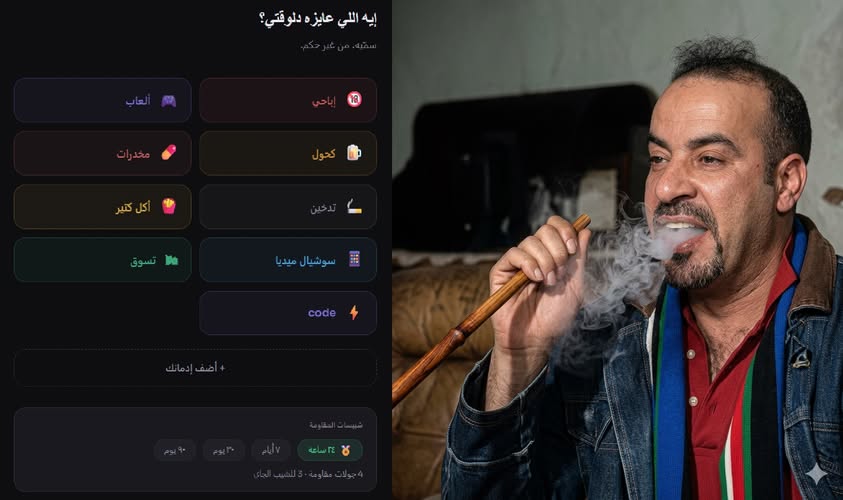
When I built the "I Want To" button in Zalfol, I built it for the moment of peak craving — the moment when everything else becomes invisible. Three options, each requiring the absolute minimum a person can manage when they're at their lowest.
The first option is to log. Record that right now, in this moment, the craving has arrived. Don't suppress it, don't pretend it isn't there — just document it. Because the first and most important step in defeating an enemy is learning to observe it precisely. When does it come? What were you thinking about? What preceded it? You can only see the pattern when you're not inside the moment.
The second option is to fight — but just one round. Five minutes. A single small task from your work queue. Not to win the war. Not to prove anything. Just to win one round against your own adversary. The app keeps your score. Rounds won accumulate. One day, enough rounds won becomes a knockout.
The third option is to contact your sponsor — a specific person you've already identified and saved in your settings. Someone who knows the road because they walked it. One tap and the call or message goes out automatically. You don't have to search for them in the moment you can barely see your own hands.
Zalfol has the standard categories — the recognized, documented addictions. But you can add your own. Whatever it is that you suspect might be controlling you without your full awareness. Even if no recovery group exists for it yet.
If the only thing you take from this is the question — what might be controlling me that I haven't noticed? — that's enough. That question, asked honestly, is where everything begins.