You know the morning. Everything is working. You made your coffee, you feel the day opening in front of you — optimistic, clear, almost light. And then, from nowhere, with no trigger you can name, no conversation that went wrong, no message you read: the ceiling drops. You're anxious. You're irritable. You resent the people around you and the work in front of you and yourself most of all. And you have absolutely no idea why.
For most people, this happens occasionally. The feeling passes within an hour, or the coffee kicks in, or life just re-levels on its own. The swing is small. The duration is short.
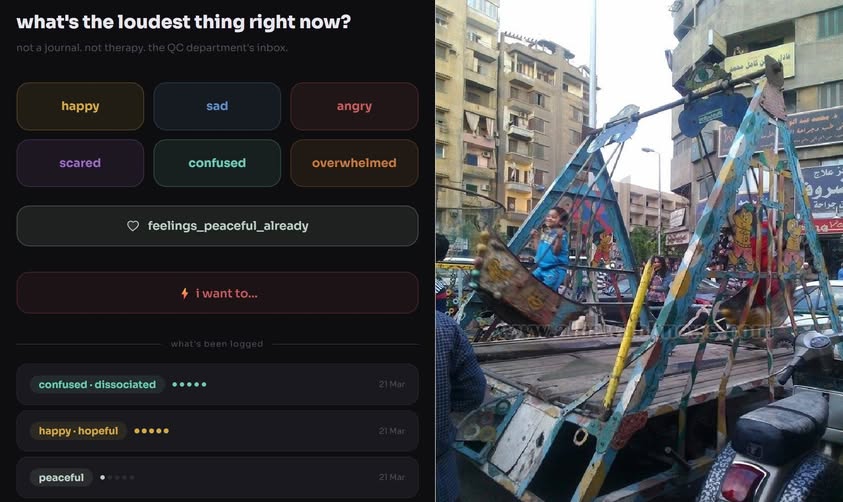
For those of us with ADHD, this is the entire interior weather system. Ten times an hour, sometimes more. From the absolute bottom of the ocean to the highest possible peak — and back. Not the days-long swings of bipolar disorder. Something faster, something more relentless, something that feels like being on a swing that nobody is pushing but that never stops moving.
It is not the moods themselves that exhaust you. It is not knowing where they came from.
The Person Who Can't Hold Their Nose
Imagine walking through a city with no ability to block your sense of smell. You pass a pile of garbage — and for a moment, you are flooded with it. Then you walk a few steps. You forget there was garbage. You forget you smelled anything at all. But something lingers. A mood. A tightening somewhere in the chest. An inexplicable irritation.
And now you're in a bad mood — and you don't know why. You can't trace it back to the garbage because the working memory that would have held that connection has already let it go. So you look inward instead. You conclude that the problem is you. That you are the source of the smell. That you are somehow condemned to live with it.
Then you pass a garden. You don't remember passing it. But suddenly everything is fine — better than fine, extraordinary. The world is full of possibility. You feel the particular euphoria of someone who has just understood something fundamental about life. And two minutes later, neither the garbage nor the garden exists in your memory. Only the weather remains, shifting, shifting, shifting.
This is what ADHD emotional dysregulation actually is. Not weakness. Not instability of character. A brain with no working memory to trace the emotional residue back to its source — so the feelings arrive without addresses, and you have no map to return them to where they belong.
The Glasses
When I finally understood this — really understood it, through years of therapy and reading everything I could find about my own neurology — I understood that I needed to wear glasses. Not because my eyes are weak. Because without them, what I'm seeing is genuinely distorted. The colors aren't the real colors. The shapes aren't the real shapes.
For eight years before building Zalfol, my glasses were paper and pen. Every hour, sometimes more: What am I feeling right now? What time is it? What was I just thinking about? What happened in the last few minutes? Tables and tables and tables. Not therapy. Not journaling in the conventional sense. Data collection — because the memory that should have done this automatically wasn't doing it.
After months of this, something extraordinary happened. A map appeared. Specific emotional transitions, repeating. Specific memories that my brain kept returning to, years after they happened. Specific triggers that I had been blaming on my character — and that turned out to be patterns, traceable, predictable, navigable.
The map doesn't stop the swing. It tells you, while you're swinging, that you've been here before — and that you came back.
The decisions that changed most dramatically were the ones I had been making at the extremes. The risks I had abandoned because the swing threw me to the bottom at the moment of commitment. The impulsive choices I had made because the swing threw me to the top at exactly the wrong moment. The map didn't make me a different person. It made me someone who could see which direction the swing was moving before acting on it.
The Heart Button
When I built this into Zalfol, I faced the same problems I had seen in every person who tried to do this with pen and paper: they didn't know how to describe their feelings, they didn't know how to structure what they wrote, and they forgot to write at all. All three of these are real problems. I had all three myself.
So the design question was: what is the absolute minimum friction between a feeling and a record of it? The answer became the Heart button. You open the app, you press it, you choose the closest emotion from a scientifically-validated taxonomy — primary feeling first, then the shade of it, then its intensity. The heart changes color. It pulses at the rate of what you've described. Yellow and blue together give you green: mixed, unsettled, somewhere between.
Each entry is timestamped automatically. Each entry can hold a memory or note attached to it — the thought that was passing through, the thing that just happened. And over time, Box 5 in the six-box system builds the map: your emotional transitions, your recurring patterns, the shape of your particular weather system.
For paid users, there is now an AI layer that reads the data with you — that can answer the question you are probably already asking: what does all this mean? But even without it, the data is yours. Visible. Readable. For the first time in perhaps a long time, you can look at the street where the garbage was — and understand why you've been carrying the smell all morning.
That is not a small thing. That is, for people like us, one of the largest things there is. والله أعلم.